There are cakes that people politely enjoy and then there are cakes that stop conversation entirely. This Mango Coconut Cake recipe homemade falls firmly into the second category. The combination of fragrant coconut sponge, intensely tropical mango curd filling, and silky coconut cream frosting creates something that tastes genuinely like a holiday in every single bite. I made this for a summer birthday and it was the first time I ever saw someone photograph their cake before the candles were even lit.
This tropical mango coconut layer cake is not complicated — it is just specific about its ingredients and respectful of the technique. The mango brings sweetness and brightness. The coconut brings richness and depth. Together they create a summer mango coconut cake that earns its place as the centerpiece of any table it appears on.
Servings: 12 to 14 slices Prep Time: 35 minutes Bake Time: 28 to 33 minutes per layer Chilling Time: 3 to 4 hours minimum Total Time: Approximately 5 to 6 hours including chilling
What You Need — The Complete Ingredients List
This simple mango coconut cake from scratch uses four key components. Here is everything for a two-layer 20cm round cake:
For coconut sponge layers:
- 2.5 cups all-purpose flour, sifted
- 2 teaspoons baking powder
- 1/2 teaspoon baking soda
- 1/2 teaspoon salt
- 200g unsalted butter, room temperature
- 1.5 cups granulated white sugar
- 3 large eggs, room temperature
- 1 cup full-fat canned coconut milk (shaken well before opening)
- 1/3 cup whole milk, room temperature
- 1/4 cup vegetable oil
- 2 teaspoons pure vanilla extract
- 1.5 teaspoons coconut extract
- 1/2 cup sweetened shredded coconut, folded in at the end
Mango curd filling:
- 350g ripe mango puree, strained (from 2 large ripe mangoes or good quality canned puree)
- 3 large eggs
- 2 large egg yolks
- 130g granulated sugar
- 2 tablespoons fresh lime juice
- Zest of 1 lime
- 70g cold unsalted butter, cubed
- 1/4 teaspoon salt
For the coconut cream frosting:
- 450g unsalted butter, completely room temperature
- 5 to 6 cups powdered sugar, sifted
- 5 tablespoons full-fat canned coconut milk
- 1.5 teaspoons coconut extract
- 1 teaspoon pure vanilla extract
- 1/4 teaspoon salt
For decoration:
- 1 large ripe mango, thinly sliced or diced
- 1/2 cup toasted coconut flakes
- Edible flowers in yellow, orange, or white (optional)
- Fresh mint leaves
- Powdered sugar for light dusting
FYI, full-fat canned coconut milk is absolutely essential in both the batter and the frosting — the carton drinking coconut milk has a water content far too high for either application. Shake the can vigorously before opening to recombine any separated cream and liquid. This single ingredient distinction is the difference between a cake that tastes genuinely coconutty and one that simply smells of coconut extract.
The Making Process — Every Step in Full Detail
Step 1: Make the Mango Curd Filling First
The mango curd needs several hours to cool and set properly, so always start here before anything else. Whisk the strained mango puree, three whole eggs, two egg yolks, granulated sugar, fresh lime juice, lime zest, and salt together in a medium saucepan until completely uniform. Whisking everything together before applying heat ensures even cooking from the first moment heat touches the mixture.
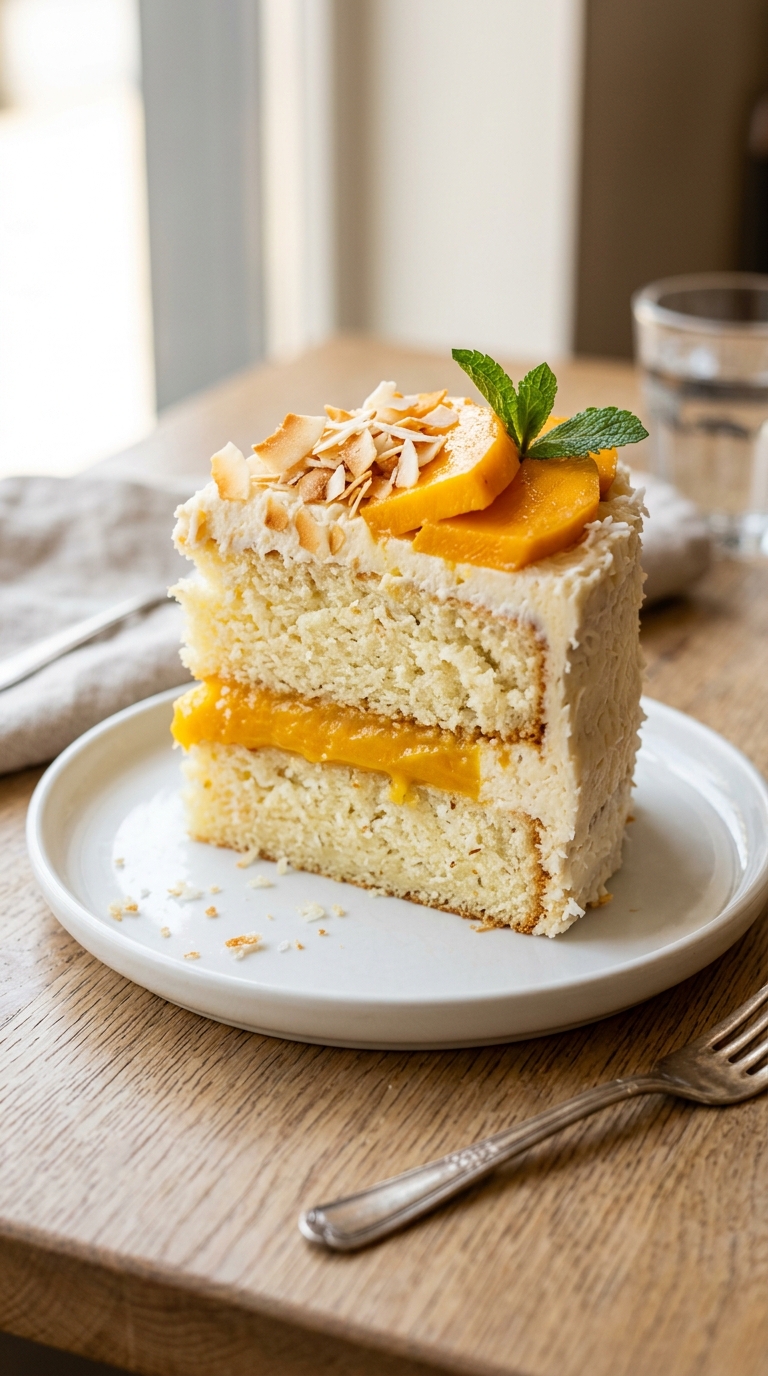
Place the pan over medium-low heat and cook, stirring constantly with a silicone spatula or wooden spoon, for twelve to fifteen minutes. Reach the corners and edges of the pan with every stroke — these areas heat fastest and the curd will thicken and potentially scramble there first if left unattended. The curd is ready when it coats the back of the spoon and holds a clean line when you drag your finger through it.
Remove from heat immediately and add the cold cubed butter in four to five additions, stirring each fully before adding the next. This cold butter mounting technique creates a glossy, silky texture that makes this mango coconut cream cake recipe easy filling genuinely exceptional. Strain through a fine mesh sieve into a bowl, press plastic wrap directly onto the surface, and refrigerate for at least three hours until fully set and cold.
Step 2: Bake the Coconut Sponge Layers
Preheat your oven to 175 degrees Celsius. Grease two 20cm round cake pans, line the bottoms with parchment paper circles, grease the parchment, and dust the sides lightly with flour. This three-step preparation is genuinely non-negotiable — coconut-based batters can be slightly stickier than standard vanilla batters due to the natural oils in the coconut milk and shredded coconut, and even well-greased pans occasionally stick without the parchment layer as an additional barrier.
Sift flour, baking powder, baking soda, and salt together in a bowl and set aside. Combine canned coconut milk, whole milk, vanilla extract, and coconut extract in a separate jug and stir. Beat room-temperature butter and vegetable oil together on medium speed for two minutes until smooth, add granulated sugar, and beat on medium-high for four full minutes until very pale, fluffy, and well-aerated — scraping the bowl twice during this time for complete incorporation.
Add the three room-temperature eggs one at a time, beating 30 seconds after each on medium speed. Add the dry ingredients and coconut milk mixture in three alternating additions on the lowest speed, beginning and ending with dry, mixing just until each disappears. Fold in the sweetened shredded coconut by hand with a rubber spatula — six to eight gentle folds. Divide evenly between the two pans, level, tap three times each, and bake for 28 to 33 minutes until a toothpick comes out with just a few moist crumbs. Cool completely before any assembly.
Step 3: Make the Coconut Cream Frosting
Beat 450g of completely room-temperature butter on medium-high speed for five full minutes until it looks pale, whipped, and noticeably lighter in color and texture. This extended pre-beating before any sugar is added is what creates the ultra-light, fluffy coconut cream frosting that makes this fluffy coconut mango cake recipe so exceptional. Under-beaten butter produces dense, heavy frosting that tastes greasy rather than light and smooth.
Add the sifted powdered sugar in three to four additions on the lowest speed, mixing briefly after each to prevent clouds of powdered sugar escaping the bowl. Add the canned coconut milk, coconut extract, vanilla, and salt. Beat on medium-high for three more minutes until the frosting looks completely smooth, bright white, and holds confident soft peaks. Taste and adjust — more coconut extract for a stronger tropical punch, a touch more salt to balance sweetness if needed.
Refrigerate the finished frosting for fifteen minutes if your kitchen is warm — slightly firmed frosting spreads and pipes significantly more cleanly and holds its shape much better during the assembly process than room-temperature soft frosting. This is especially important for the mango coconut birthday cake design finish where clean lines and defined piped details make the difference between a polished result and a soft, melting one.
Step 4: Level, Fill, and Stack the Cake
Level both completely cooled sponge layers with a long serrated knife — removing any domed tops to create perfectly flat surfaces that stack cleanly. Place a small dab of coconut frosting on your cake board or serving plate, then position the first layer flat-side down on the board and press lightly so it adheres. Flat, level layers are the foundation of every well-assembled layer cake.
Spread a generous layer of coconut cream frosting over the first layer — approximately half a centimeter thickness — reaching all the way to the outer edge evenly. Now spoon the set, cold mango curd over the center of the frosting layer, leaving a border of about 1.5cm of plain coconut frosting around the outer edge. This frosting border contains the mango curd during the weight of the second layer placement and prevents it from seeping over the sides during assembly.
Place the second cake layer flat-side up on top and press gently and evenly across the entire surface. The flat top surface of the second layer provides the smoothest possible canvas for the outer frosting. Check the assembled cake for level from all angles — press gently on any higher side to correct before the layers set into position. Refrigerate the stacked, filled cake for 20 minutes before applying any outer frosting.
Step 5: Apply the Crumb Coat and Final Frosting Layer
Apply a thin, even crumb coat of coconut cream frosting over the entire exterior of the chilled stacked cake — top and all sides — using an offset spatula. The crumb coat seals all loose crumbs from the cut cake surfaces against the exterior, preventing them from appearing in the final decorated layer. For this tropical fruit mango coconut cake, the pale cream frosting makes any crumbs particularly visible, so a thorough crumb coat is especially important.
Refrigerate the crumb-coated cake for another 20 to 30 minutes until the thin frosting layer feels completely firm and set to the touch. This chilling step provides a stable foundation for the final frosting layer and prevents the colors and crumbs from mixing into the outer coat during application. Skipping it almost always results in a slightly streaky, crumb-marked final surface that requires additional passes with the spatula to correct :/
Apply the final generous outer layer of coconut cream frosting over the chilled crumb coat. Use a bench scraper held vertically against the side of the cake and rotate the turntable slowly for smooth, even sides. Use an offset spatula for the top — pulling inward from the outer edge toward the center in short, controlled strokes to create a flat, clean top edge. This smooth white coconut frosting exterior is the perfect backdrop for the vibrant mango and toasted coconut decoration.
Step 6: Decorate and Present the Finished Cake
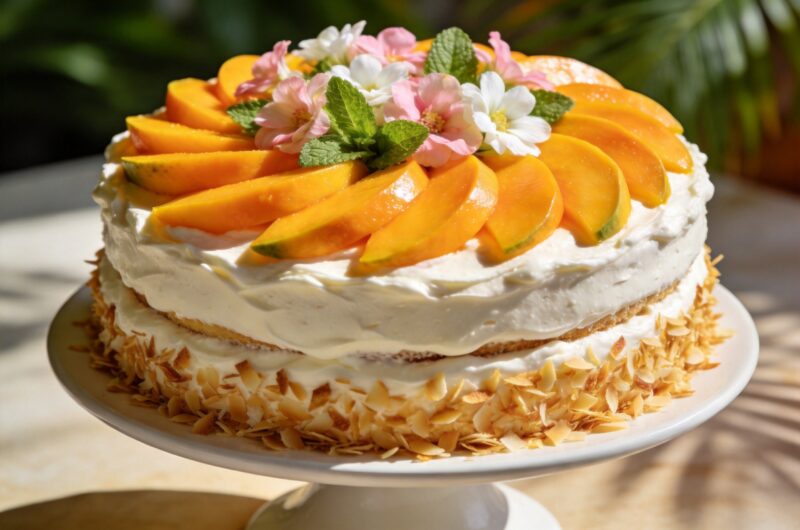
Press toasted coconut flakes around the lower third of the cake sides while the outer frosting is still slightly tacky — use the palm of your hand held against the frosting and rotate around the cake. The toasted coconut adds both visual texture and an additional layer of coconut flavor in every bite from the outer edge. Toast raw coconut flakes in a dry pan over medium heat, stirring constantly for three to four minutes until golden and fragrant.
Arrange fresh mango slices or cubes across the top of the cake in a visually abundant, slightly overlapping pattern that covers most of the top surface. Brush the arranged mango pieces lightly with a small amount of warmed, strained apricot jam or mango jam — this adds a professional gloss and prevents the cut mango from oxidizing and browning before serving. Add edible flowers and fresh mint leaves tucked between the mango pieces for color contrast and fragrance.
Dust the very edges of the top surface lightly with powdered sugar for a soft finishing detail. Refrigerate the fully decorated cake for at least one hour before serving to allow everything to firm up and settle. Bring to room temperature for twenty minutes before slicing — cold coconut frosting can feel dense and waxy straight from the refrigerator while the same frosting at slightly below room temperature is smooth, melting, and genuinely wonderful IMO 🙂
Why This Flavor Combination Works So Well
The moist mango coconut cake dessert success comes from specific ingredient interactions:
- Coconut milk in the batter: Replaces regular liquid and adds fat and natural sweetness that no amount of extract alone can replicate
- Mango curd as filling: The lime brightness in the curd prevents the overall cake from tasting one-dimensionally sweet and tropical
- Coconut extract in frosting: Amplifies the coconut character throughout without requiring additional liquid that would destabilize the frosting
- Shredded coconut in the batter: Adds texture variation and concentrated coconut flavor in every slice
- Toasted coconut on exterior: The toasting process deepens and nutty-ifies the coconut flavor significantly compared to raw shredded coconut
Variations Worth Trying
Pineapple and Mango Coconut Version
Replace half the mango curd filling with a thin layer of crushed pineapple — drain a can of crushed pineapple very thoroughly and mix with one tablespoon of sugar. Layer the pineapple directly over the mango curd filling between the layers. The pineapple adds a sharper, more acidic fruit note that contrasts beautifully with the rich coconut frosting and makes this easy mango coconut cake recipe feel even more tropical and vibrant in every bite.
Lime and Mango Coconut Version
Add the zest of two limes to the coconut sponge batter along with the other wet ingredients. Replace two tablespoons of whole milk in the batter with two tablespoons of fresh lime juice. Increase the lime zest in the mango curd to two limes. The additional lime throughout the whole cake amplifies the citrus brightness that already exists in the curd and creates a more complex, layered tropical flavor profile.
Common Mistakes to Avoid
For a perfect fluffy coconut mango cake recipe result:
- Using carton coconut milk: Too much water — always use full-fat canned coconut milk for both batter and frosting
- Skipping the mango curd chill time: Warm curd runs out from between the layers immediately — always refrigerate for minimum three hours
- Under-beating the butter for frosting: Dense, greasy frosting results — five full minutes of beating before any sugar is genuinely required
- Adding shredded coconut with the mixer: Breaks the coconut strands into tiny pieces — always fold in by hand with a rubber spatula
- Serving straight from the refrigerator: Cold coconut frosting feels waxy — always bring to slightly below room temperature before serving
Mango Coconut Cake That Tastes Like a Tropical Holiday
12
servings35
minutes30
minutesThis Mango Coconut Cake bakes fragrant coconut sponge layers, fills them with a silky lime-brightened mango curd, frosts them in a light coconut cream buttercream, and decorates with fresh mango and toasted coconut flakes. Serving 12 to 14 people, it delivers a stunning tropical celebration cake from scratch.
Ingredients
Coconut Sponge Layers:
2.5 cups all-purpose flour, sifted
2 teaspoons baking powder
1/2 teaspoon baking soda
1/2 teaspoon salt
200g unsalted butter, room temperature
1.5 cups granulated white sugar
3 large eggs, room temperature
1 cup full-fat canned coconut milk
1/3 cup whole milk, room temperature
1/4 cup vegetable oil
2 teaspoons vanilla extract
1.5 teaspoons coconut extract
1/2 cup sweetened shredded coconut
Mango Curd Filling:
350g ripe mango puree, strained
3 large eggs
2 large egg yolks
130g granulated sugar
2 tablespoons fresh lime juice
Zest of 1 lime
70g cold unsalted butter, cubed
1/4 teaspoon salt
Coconut Cream Frosting:
450g unsalted butter, room temperature
5 to 6 cups powdered sugar, sifted
5 tablespoons full-fat canned coconut milk
1.5 teaspoons coconut extract
1 teaspoon vanilla extract
1/4 teaspoon salt
Decoration:
1 large ripe mango, sliced or diced
1/2 cup toasted coconut flakes
Edible flowers (optional)
Fresh mint leaves
Powdered sugar for dusting
- Whisk strained mango puree, eggs, egg yolks, sugar, lime juice, lime zest, and salt together in a saucepan until uniform, cook over medium-low heat stirring constantly for twelve to fifteen minutes until thickened, mount with cold cubed butter in additions, strain into a bowl, cover surface with plastic wrap, and refrigerate minimum three hours
- Preheat oven to 175 degrees Celsius and prepare two 20cm round cake pans with butter, parchment circles, and a light flour dusting
- Sift flour, baking powder, baking soda, and salt together, then combine canned coconut milk, whole milk, vanilla, and coconut extract in a separate jug
- Beat room-temperature butter and oil on medium for two minutes, add sugar and beat on medium-high for four full minutes until pale and airy, scraping the bowl twice
- Add eggs one at a time beating 30 seconds after each, then add dry ingredients and coconut milk mixture in three alternating additions on lowest speed just until each disappears
- Fold sweetened shredded coconut into the batter by hand with a rubber spatula using six to eight gentle folds
- Divide evenly between prepared pans, level, tap three times each, bake at 175 degrees Celsius for 28 to 33 minutes until a toothpick comes out with just a few moist crumbs
- Cool in pans fifteen minutes, invert onto racks, peel parchment, cool completely
- Beat 450g room-temperature butter for five full minutes until pale and whipped, add powdered sugar in additions on lowest speed, then add coconut milk, coconut extract, vanilla, and salt and beat three more minutes until fluffy
- Refrigerate frosting for fifteen minutes if the kitchen is warm
- Level both cooled layers, stack with coconut frosting filling between them and chilled mango curd over the frosting center leaving a 1.5cm border, refrigerate assembled stack twenty minutes
- Apply a thin crumb coat over the entire exterior, refrigerate twenty to thirty minutes until firm, then apply the final generous frosting layer and smooth with bench scraper and offset spatula
- Press toasted coconut flakes around the lower third of the sides while frosting is still slightly tacky, arrange fresh mango across the top, brush with warm apricot jam glaze, add edible flowers and mint leaves, dust edges with powdered sugar, refrigerate one hour before serving
Frequently Asked Questions
Q1: Can I use store-bought mango puree instead of fresh? Good quality canned Alphonso or Kesar mango puree from an Indian grocery store works excellently and often produces a more consistently sweet, fragrant curd than out-of-season fresh mangoes from a supermarket. Look for puree with no added sugar or preservatives for the cleanest flavor. If the canned puree tastes very sweet, reduce the sugar in the mango curd recipe by two tablespoons to prevent the finished filling from being overwhelmingly sweet against the coconut frosting.
Q2: How do I toast coconut flakes without burning them? Spread raw coconut flakes in a single layer across a dry, wide frying pan over medium heat. Stir constantly from the first moment they hit the pan — coconut goes from pale to golden to burnt in under thirty seconds once it starts toasting. Pull the pan off the heat when the majority of flakes look golden and smell nutty — residual heat continues toasting for another fifteen to twenty seconds after the pan leaves the burner. Cool completely before pressing onto the frosted cake.
Q3: Can I make this cake gluten-free? Replace the all-purpose flour with an equal weight of a good quality gluten-free plain flour blend that contains xanthan gum. The coconut milk, coconut extract, and shredded coconut all translate perfectly to gluten-free baking. The texture will be slightly denser and may be marginally more crumbly than the standard version, but the flavor will remain genuinely excellent. Bake time may extend by three to five minutes — start checking at the 30-minute mark with a toothpick.
Make This Cake and Bring Summer to Any Table
This mango coconut cake recipe homemade delivers a genuinely extraordinary tropical dessert that tastes as vibrant and special as it looks. Fragrant coconut sponge, bright mango curd, silky coconut frosting, and fresh mango decoration — all working together in a cake that is simultaneously elegant and joyful.
Make it for the next occasion that deserves something genuinely memorable. Or make it because it is summer and mangoes are perfect right now and you deserve something this good. Both reasons are entirely valid 🙂