For a long time I treated protein smoothies like medicine — something to get through quickly rather than actually enjoy. Then I figured out the right ingredient ratios, the correct blending order, and a few simple additions that transform the whole experience. Now I genuinely look forward to making one every morning.
This recipe gives you a thick, creamy, genuinely satisfying protein smoothie that works as a healthy breakfast protein smoothie, a post workout protein smoothie, or a quick meal replacement. It takes six minutes, uses one blender, and delivers around 35 grams of protein per serving without tasting like a gym supplement catalogue.
What You’ll Need (Ingredients)
These are the base ingredients for the classic chocolate banana version. Variations follow later in the article.
For the base smoothie:
- 2 medium ripe bananas, peeled and frozen — approximately 240g total
- 2 scoops vanilla or chocolate whey protein powder — approximately 60g total
- 300ml (1.25 cups) whole milk or unsweetened almond milk
- 150g (2/3 cup) plain Greek yogurt — full fat for creaminess, low fat for fewer calories
- 2 tablespoons natural peanut butter or almond butter
- 1 tablespoon honey or maple syrup — optional, adjust to taste
- 1/2 teaspoon vanilla extract
- 1 cup ice cubes
Optional add-ins for extra nutrition:
- 1 tablespoon ground flaxseed
- 1 tablespoon chia seeds
- 1 handful fresh spinach — you cannot taste it, trust the process
- 1 tablespoon cocoa powder — for a chocolate protein smoothie version
How to Make It — Full Step-by-Step Process
Step One: Freeze Your Bananas Ahead of Time
This step happens the night before, and it makes a bigger difference than most people realise. Peel your 2 ripe bananas and break each one into 3 to 4 chunks. Place the chunks in a single layer on a small baking tray lined with parchment paper and put them in the freezer for at least 4 hours — overnight works best.
Frozen banana does three important things in this recipe. First, it thickens the smoothie to a genuinely creamy, almost ice-cream-like consistency without needing extra ice. Second, freezing intensifies the natural sweetness of the banana, which means you need less added sweetener in the final drink. Third, frozen banana keeps the smoothie cold and thick for longer after blending, so it does not turn into a warm, watery liquid five minutes after you make it. If you forget to freeze the bananas, use fresh ones and double the ice — the texture will be slightly thinner but the flavour stays excellent.
Step Two: Add Ingredients to the Blender in the Right Order
The order in which you add ingredients to the blender directly affects how smoothly and evenly everything blends. This is one of those small details that separates a great smoothie from a lumpy, uneven one — and it takes zero extra effort to get right.
Start by pouring 300ml of milk into the blender first. Liquid always goes in at the bottom because it gives the blender blades something fluid to pull through immediately when the motor starts. This protects the motor from straining against a solid block of frozen fruit and protein powder sitting directly on the blades.
Next, add the 150g of Greek yogurt directly onto the liquid. Then add 2 tablespoons of peanut butter. After that, add the 2 scoops of protein powder. Now add your frozen banana chunks on top of everything else. Finally, add the cup of ice cubes right at the very top. This layering keeps the dense, sticky ingredients away from the blades during the initial seconds of blending, which produces a smoother, more consistent result throughout the entire smoothie.
If you are adding any optional extras like spinach, flaxseed, chia seeds, or cocoa powder, add them after the yogurt and before the protein powder so they blend fully into the base rather than sitting in undissolved pockets.
Step Three: Blend Correctly for the Best Texture
Secure the blender lid firmly — hold it down with one hand during the first few seconds if your blender tends to vibrate. Start on a low speed setting for the first 10 seconds. This initial low-speed blend breaks up the larger frozen banana chunks and ice cubes into smaller pieces without the blender struggling or overheating trying to force the motor through solid frozen material.
After 10 seconds on low, increase to the highest speed your blender offers and blend for a full 45 to 60 seconds continuously. Do not stop and start during this phase — continuous high-speed blending produces a smoother, more uniform texture than repeated short bursts. You should hear the blender sound shift from a loud, laboured motor noise as it breaks down the frozen ingredients to a smoother, more consistent whirring sound as everything becomes uniformly blended.
Stop the blender and check the consistency. The smoothie should look thick, smooth, and completely uniform in colour with no visible chunks or streaks of unmixed protein powder. If you spot any white streaks of protein powder on the sides of the blender jug, scrape them down with a spatula, replace the lid, and blend for another 15 seconds. Protein powder has a tendency to cling to the sides of the blender rather than incorporating fully on the first blend, especially when it is added in a large quantity.
Step Four: Check and Adjust Consistency
Pour a small amount — about 2 tablespoons — into a glass and assess the thickness before serving. A great protein smoothie should pour slowly and hold its shape slightly in the glass rather than spreading immediately like thin juice.
If the smoothie feels too thick to pour at all, add 2 tablespoons of milk and blend for 10 seconds. Repeat until it reaches your preferred consistency. If it feels too thin, add 4 to 5 more frozen banana chunks or a small handful of ice and blend again for 20 seconds. Getting the consistency right takes one attempt to learn and then becomes instinctive every time after that.
Taste the smoothie at this stage as well. If needs more sweetness, add 1 teaspoon of honey and blend for 5 seconds. For Example if needs more protein flavour, add half a scoop of protein powder and blend again briefly. If the banana flavour feels too dominant, a small squeeze of fresh lemon juice — about 1 teaspoon — brightens the whole flavour and pulls it back into balance.
Step Five: Pour and Serve
Pour the finished smoothie evenly between two glasses. Pour slowly from a height of about 20cm above the glass — this creates a slight froth on the surface from the air incorporated during pouring, which improves the texture and visual appeal noticeably. Fill each glass to about 1cm below the rim.
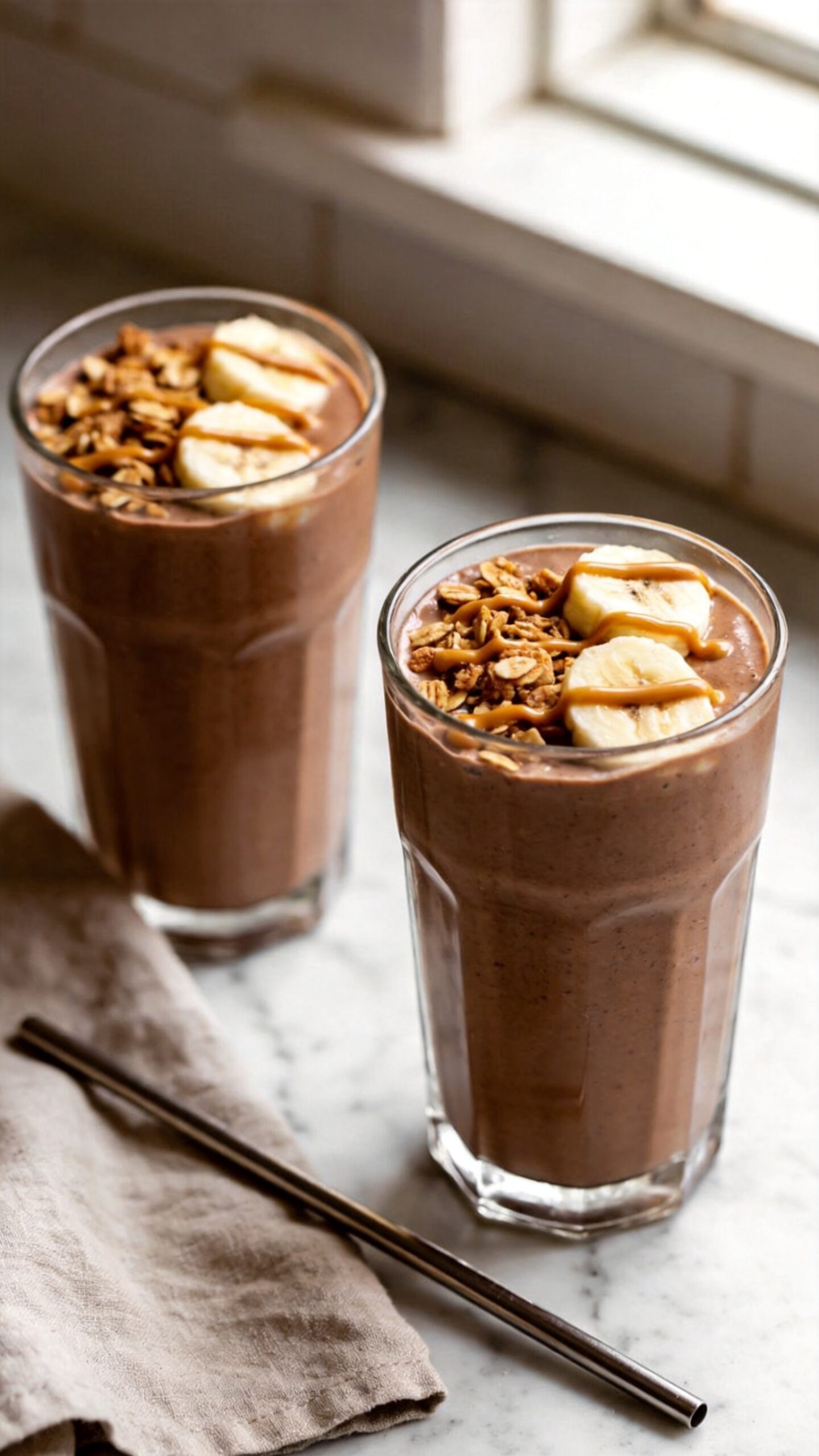
If you want to make this look genuinely impressive — which takes about 30 extra seconds — add a few toppings directly onto the surface of the smoothie before serving. A light sprinkle of granola adds crunch. A drizzle of peanut butter in a thin line across the top adds visual richness. A few banana slices laid across the rim of the glass complete the presentation. These additions are entirely optional, but they genuinely make the difference between a drink that looks like a quick protein shake and one that looks like a breakfast worth sitting down for. 🙂
Why This Recipe Beats a Standard Protein Shake
Have you ever wondered why a blended smoothie leaves you full for hours while a shaken protein powder drink barely keeps you satisfied until mid-morning? The answer is fibre, fat, and food volume. This recipe combines Greek yogurt, banana, and nut butter alongside the protein powder, which means your body digests the whole thing more slowly and stays satisfied significantly longer.
A standard scoop-and-shake protein powder drink typically delivers 25 grams of protein with minimal fibre and almost no fat. This smoothie delivers approximately 35 grams of protein per serving alongside healthy fats from the nut butter, natural sugars from the banana, and probiotics from the Greek yogurt. It functions as a complete, balanced meal rather than just a protein top-up.
Variations for Every Goal
Protein Smoothie for Weight Loss
For a low calorie protein smoothie recipe that still keeps you full, make these swaps. Replace whole milk with unsweetened almond milk — saving approximately 60 calories per serving. Use low-fat Greek yogurt instead of full-fat. Reduce peanut butter to 1 tablespoon and skip the honey entirely. The total drops to approximately 245 calories per serving while still delivering over 30 grams of protein.
Post Workout Protein Smoothie
Add 1 tablespoon of ground oats and increase the banana to 3 frozen pieces for this version. The extra carbohydrates from the oats and banana replenish muscle glycogen quickly after training, while the protein supports immediate muscle repair. This version works best consumed within 30 to 45 minutes after finishing a workout for maximum recovery benefit.
Vegan Protein Smoothie Recipe
Replace whey protein powder with a plant-based protein powder — pea protein or brown rice protein both blend well here. Swap Greek yogurt for coconut yogurt or silken tofu, which adds creaminess without dairy. Use oat milk or almond milk as the liquid base. This vegan protein smoothie recipe delivers around 28 grams of protein per serving — excellent for a fully plant-based option.
Chocolate Protein Smoothie
Add 1 tablespoon of unsweetened cocoa powder to the base recipe alongside the protein powder. Use chocolate protein powder instead of vanilla for a deeper, richer chocolate flavour throughout. A pinch of sea salt added to chocolate protein smoothie ideas enhances the cocoa flavour significantly — the same way salt enhances chocolate in baking. This version tastes like a chocolate milkshake that happens to contain 35 grams of protein.
Tips for Getting Maximum Protein Without Ruining the Taste
Choose a good protein powder: The quality of your protein powder affects the taste of every smoothie you make. Whey isolate blends more smoothly and tastes cleaner than whey concentrate. Plant-based proteins can taste grainy if you use the wrong brand — try a few before committing to a large bag.
Do not skip the fat: Peanut butter, almond butter, or Greek yogurt all add essential fat that makes the smoothie satisfying and helps your body absorb fat-soluble vitamins from any greens you add. A fat-free protein smoothie leaves you hungry within an hour regardless of how much protein it contains.
Add greens without tasting them: A large handful of fresh spinach adds iron, folate, and fibre without adding any detectable flavour when blended with banana and chocolate protein powder. This is probably the easiest way to add vegetables to your diet — and IMO it borders on cheating in the best possible way.
Storing and Meal Prepping Your Smoothies
This recipe works well for batch preparation if you want to save time during busy mornings. Blend a double batch — four servings — and store in sealed mason jars in the fridge for up to 24 hours. Shake or stir before drinking because natural separation occurs as the smoothie sits. The texture changes slightly after refrigeration but the flavour and nutritional value remain completely intact.
For longer storage, pour individual portions into freezer-safe containers and freeze for up to 1 month. Thaw in the fridge overnight and blend briefly for 10 seconds before serving to restore a smooth, creamy consistency. FYI, this freezer method works brilliantly for anyone who wants genuinely effortless high protein smoothie recipes ready to go every morning without any morning prep at all.
Common Mistakes to Avoid
Using warm milk: Warm liquid melts the frozen banana too quickly during blending and produces a thin, lukewarm smoothie with poor texture. Always use cold milk straight from the fridge.
Adding protein powder first: Protein powder added before the liquid sits directly on the blades and creates a thick paste that clogs the blender immediately. Always add liquid first, every single time.
Under-blending: Thirty seconds is not enough for frozen banana and ice. Blend on high for a full 60 seconds to achieve a genuinely smooth, creamy result with no icy chunks remaining.
Using unripe bananas: Unripe bananas taste starchy and slightly bitter in a smoothie. Ripe bananas — with brown spots on the skin — taste sweeter, blend more smoothly, and produce a noticeably better flavour in the finished drink.
Easy Protein Smoothie for Breakfast or Post Workout
2
servings5
minutes1
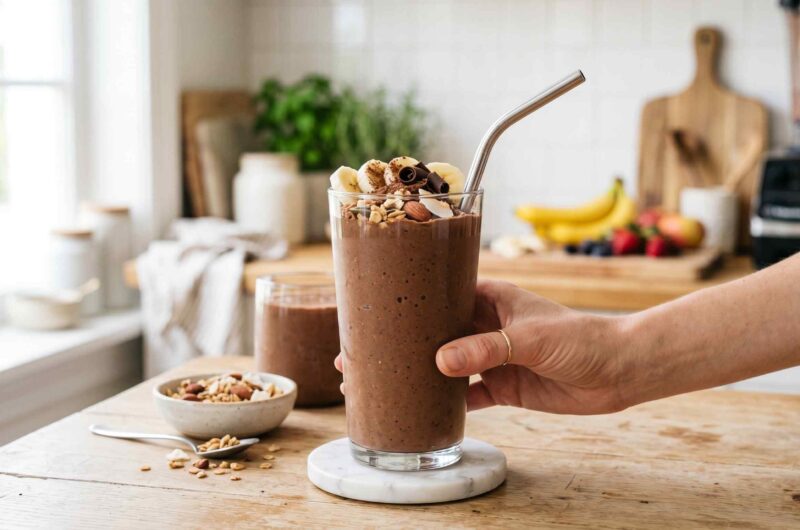
minuteThis protein smoothie combines frozen banana, Greek yogurt, peanut butter, and protein powder blended with cold milk into a thick, creamy, genuinely satisfying drink. Ready in just 6 minutes and delivering around 35 grams of protein per serving, it works perfectly as a breakfast, post workout recovery drink, or meal replacement.
Ingredients
Base smoothie:
2 medium frozen ripe bananas (240g)
2 scoops protein powder (60g)
300ml whole milk or almond milk
150g plain Greek yogurt
2 tablespoons natural peanut butter
1 tablespoon honey or maple syrup (optional)
1/2 teaspoon vanilla extract
1 cup ice cubes
Optional add-ins:
1 tablespoon ground flaxseed
1 tablespoon chia seeds
1 handful fresh spinach
1 tablespoon cocoa powder
- Peel and chop 2 ripe bananas into chunks the night before and freeze overnight
- Take frozen banana chunks out of the freezer when ready to blend
- Pour 300ml cold milk into the blender first
- Add 150g Greek yogurt directly onto the milk
- Add 2 tablespoons of peanut butter on top of the yogurt
- Add any optional extras like spinach, flaxseed, or cocoa powder now
- Add 2 scoops of protein powder on top of everything
- Place frozen banana chunks into the blender last
- Add 1 cup of ice cubes on top of the banana
- Secure the blender lid firmly and blend on low speed for 10 seconds
- Increase to highest speed and blend continuously for 45 to 60 seconds
- Stop and check for any white protein powder streaks on the sides
- Scrape down the sides with a spatula if needed and blend for 15 more seconds
- Check consistency — add milk if too thick, add ice or banana if too thin
- Taste and adjust sweetness with honey or protein flavour as needed
- Pour slowly from a height into two glasses filling each to 1cm below the rim
- Add optional toppings like granola, banana slices, or a peanut butter drizzle
- Serve immediately for the best texture and temperature
FAQs
Q1: How much protein does this smoothie actually contain?
Each serving of this base recipe contains approximately 34 to 36 grams of protein, depending on the protein powder brand you use. The Greek yogurt contributes around 10 grams, the protein powder adds approximately 20 grams, and the peanut butter provides the remaining 4 to 5 grams. This makes it one of the most complete high protein smoothie recipes available without requiring multiple supplements.
Q2: Can I make this without protein powder?
Yes. Replace the protein powder with an extra 150g of Greek yogurt and add 2 tablespoons of hemp seeds. This combination delivers approximately 22 to 25 grams of protein per serving without any supplement powder. The texture turns out slightly lighter and the flavour tastes more naturally food-based, which many people actually prefer.
Q3: Is this smoothie good for weight loss?
Yes, particularly the low calorie version outlined earlier. High protein intake supports satiety, reduces overall appetite, and helps preserve lean muscle mass during a calorie deficit. A protein smoothie for weight loss works best as a meal replacement for breakfast or lunch rather than as an addition to your existing meals.
Q4: Can children drink this protein smoothie?
Children can safely consume this smoothie without the protein powder — simply remove the supplement and let the Greek yogurt, nut butter, and milk provide the protein naturally. The base version without powder contains around 15 grams of protein per serving, which is appropriate and nutritionally balanced for most children over 3 years old.
Q5: Why does my smoothie taste gritty or chalky?
Grittiness almost always comes from the protein powder not blending fully into the liquid. This happens most often when protein powder goes into the blender before the liquid, when the blending time is too short, or when the protein powder quality is low. Always add liquid first, blend on high for a full 60 seconds, and try a higher quality whey isolate powder if the problem persists.
Wrapping It Up
This protein smoothie recipe gives you everything you need — great taste, high protein content, real satiety, and total flexibility to adjust for weight loss, muscle gain, or a vegan lifestyle. Freeze your bananas the night before, add ingredients in the correct order, blend on high for a full minute, and taste before serving — those four habits make every batch come out perfectly.
Whether you make the classic banana version, the chocolate variation, or the post workout recovery build, this smoothie delivers consistently. Now go make one and actually enjoy your morning protein.